Sea freight and air freight from Tokyo, Yokohama, Osaka, Kobe and Nagoya to all major Indian ports and airports — costs, transit times, customs and documentation.
Japan and India share one of Asia’s most significant bilateral trade relationships. With trade volumes exceeding USD 20 billion annually, Japan is a major source of high-precision machinery, automotive components, electronics, chemicals and industrial equipment for Indian manufacturers and businesses. The Japan–India Comprehensive Economic Partnership Agreement (CEPA) provides preferential tariff treatment on many goods — making it important to correctly claim CEPA benefits at Indian customs to reduce your duty burden.
Unlike the China-India corridor which is dominated by high-volume commodity shipments, Japan–India freight is typically characterised by higher-value, precision goods — automotive parts, machine tools, industrial robots, specialty chemicals and electronics. This means air freight plays a proportionally larger role on the Japan–India lane than on many other corridors, particularly for urgent spare parts and time-sensitive industrial components.
This guide covers everything an Indian importer needs to know about shipping from Japan to India in 2026 — which port to use in Japan, which Indian port to target, realistic costs, transit times, CEPA documentation and customs clearance.
Need a shipping quote from Japan to India? WhatsApp our team — complete quote within 1 hour including CEPA duty guidance.
Japan is India’s fourth largest source of foreign direct investment and a long-standing industrial partner. The CEPA signed between India and Japan provides duty concessions on thousands of tariff lines — meaning Japanese goods enter India at preferential customs duty rates compared to standard MFN rates. For importers, this makes correct documentation critical: a valid Certificate of Origin under CEPA is the difference between paying preferential duty or standard duty on every shipment.
Japan exports precision machinery, automotive components, industrial robots, specialty chemicals and advanced electronics to India. These are higher value-per-kg goods compared to most other corridors — which means air freight is often justified even for moderate weights where speed of delivery is commercially critical.
The India-Japan Comprehensive Economic Partnership Agreement (CEPA) offers preferential duty rates on qualifying goods. To claim CEPA benefits at Indian customs, you need a valid Certificate of Origin (Form A or CEPA COO) issued by the authorised body in Japan. Without it, standard MFN duty applies — which is higher.
India is the world’s third largest automobile market and Japan’s automotive OEMs have deep roots in India — Suzuki, Honda, Toyota and Yamaha all have major Indian manufacturing operations that import Japanese components regularly. This generates consistent, high-priority freight on the Japan–India lane.
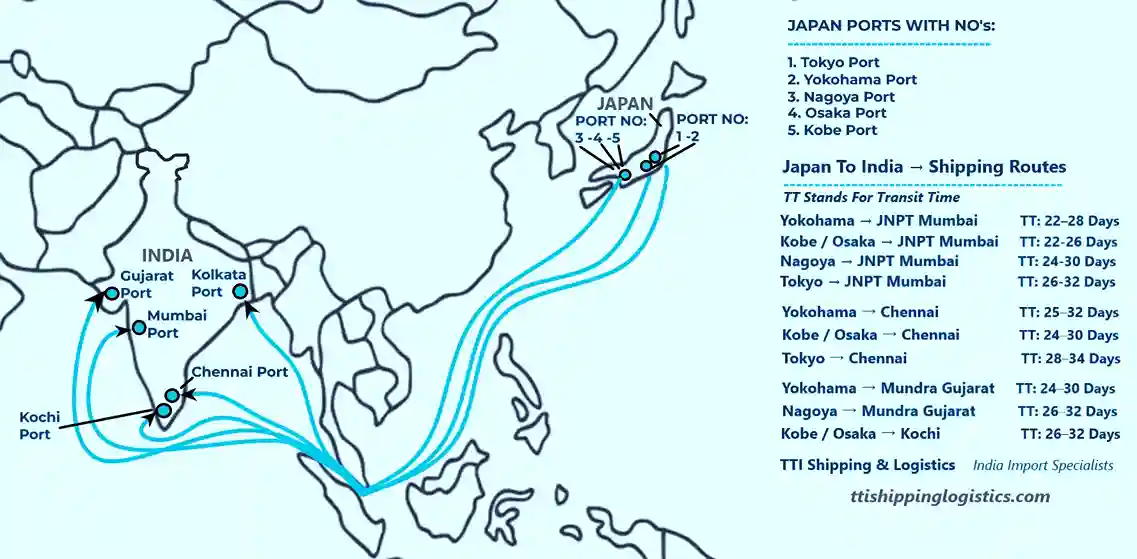
Japan’s five major cargo ports — Tokyo, Yokohama, Nagoya, Osaka and Kobe — all offer regular LCL and FCL services to India. Most services route via transshipment at Singapore or Port Klang, though direct services exist on key routes. Yokohama and Kobe have the strongest direct connectivity to Indian ports.
Sea freight is the most economical option for shipments from Japan to India above 1–2 CBM. Japan’s ports are well-connected to India via two main routing options — direct services through the South China Sea and Strait of Malacca, and transshipment services via Singapore or Port Klang (Malaysia). Most LCL consolidations route via transshipment. Direct FCL services are available on main routes but with less frequency than from China.
LCL is the right choice for Japan–India shipments below 12–15 CBM. Your cargo is consolidated with other shippers’ goods in a shared container. Japan has reliable weekly LCL consolidation services from Yokohama, Tokyo, Osaka and Kobe, typically routing via Singapore or Port Klang transshipment before onward sailing to Indian ports. LCL is especially popular for Japanese machinery spare parts, chemicals and electronics samples.
FCL is the right choice for shipments above 12–15 CBM, heavy machinery, full production runs, or when cargo integrity is critical. Direct FCL services are available from Yokohama, Kobe and Nagoya to JNPT Mumbai and Chennai. For other Japan port and India port combinations, a transshipment call may be involved. Japan’s ports handle FCL efficiently with strong documentation practices — export customs clearance in Japan is typically faster than many other origins.
Routes via South China Sea and Strait of Malacca. Some services transship at Singapore or Port Klang. Transit times are port-to-port — add 5–10 days for full door-to-door.
| Japan Origin Port | India Destination Port | Transit Time | Service Type | Best For |
|---|---|---|---|---|
| Yokohama | JNPT Mumbai | 22–28 days | Direct / Transship Most Popular | Maharashtra, North India |
| Kobe / Osaka | JNPT Mumbai | 22–26 days | Direct Fastest Sea | West & North India |
| Nagoya | JNPT Mumbai | 24–30 days | Transship Singapore | Automotive parts, machinery |
| Yokohama | Mundra, Gujarat | 24–30 days | Direct / Transship | Gujarat, Rajasthan, North India |
| Kobe / Osaka | Chennai | 24–30 days | Transship Singapore | South India, Tamil Nadu |
| Tokyo | JNPT Mumbai | 26–32 days | Transship Singapore / PKL | General cargo, LCL |
| Yokohama | Chennai | 25–32 days | Transship | South India Via PKL |
| Any Japan Port | Kolkata (Haldia) | 28–36 days | Transship | East India, West Bengal, Northeast |
| Any Japan Port | Kochi | 26–32 days | Transship | Kerala, Southwest India |
Note on transit times: Japan–India sea freight frequently involves a transshipment call at Singapore or Port Klang. This adds 2–5 days compared to a hypothetical direct sailing and introduces a small risk of missed connection if there is port congestion. LCL shipments in particular almost always transship. TTI Shipping monitors sailing schedules to book the most reliable connection for your cargo.
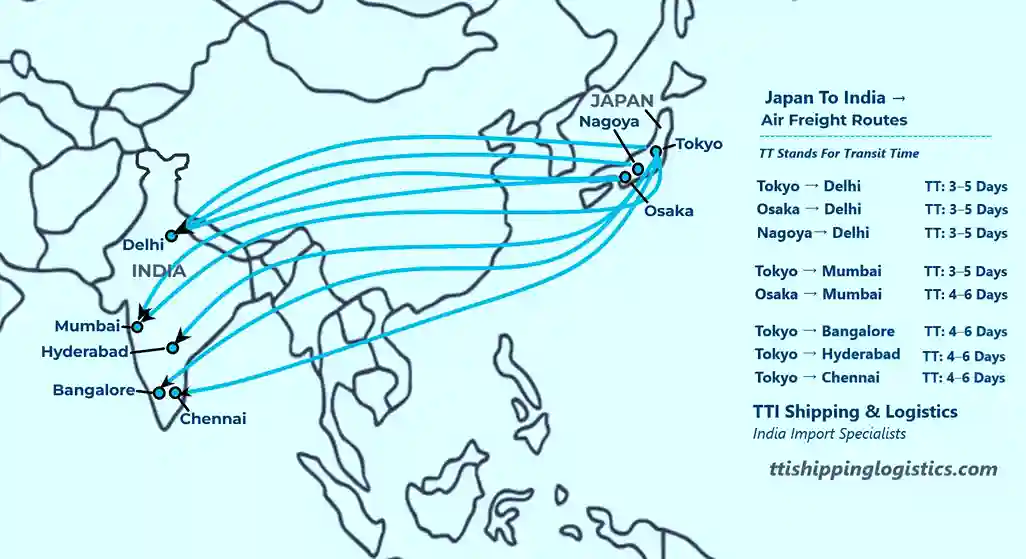
Air freight from Japan to India is well-established and frequently used for the corridor’s characteristic high-value, time-sensitive cargo. Automotive spare parts, precision instruments, electronics components and pharmaceutical ingredients commonly move by air on this lane. Japan’s primary international cargo airport is Narita (NRT) near Tokyo, with secondary cargo services from Kansai (KIX) near Osaka and Chubu Centrair (NGO) near Nagoya.
Most Japan–India air cargo moves as belly freight on passenger aircraft or dedicated freighters. Silk Way West Airlines operates dedicated freighter services on NRT–BOM.
| Japan Airport | India Airport | Flight Time | Door-to-Door | Rate (per kg) |
|---|---|---|---|---|
| Narita (NRT) Tokyo | Delhi IGI (DEL) | 9–10 hrs | 3–5 days | USD 5.00–8.00 Highest Frequency |
| Narita (NRT) Tokyo | Mumbai (BOM) | 10–11 hrs | 3–5 days | USD 5.00–8.00 Dedicated Freighter |
| Kansai (KIX) Osaka | Delhi IGI (DEL) | 9–10 hrs | 3–5 days | USD 5.00–8.00 |
| Kansai (KIX) Osaka | Mumbai (BOM) | 10–11 hrs | 4–6 days | USD 5.00–8.00 |
| Nagoya (NGO) | Delhi IGI (DEL) | 9–10 hrs | 3–5 days | USD 5.50–8.00 Auto Parts Hub |
| Narita (NRT) Tokyo | Bangalore (BLR) | 10–12 hrs | 4–6 days | USD 5.50–8.00 |
| Narita (NRT) Tokyo | Hyderabad (HYD) | 10–12 hrs | 4–6 days | USD 5.50–8.00 |
| Narita (NRT) Tokyo | Chennai (MAA) | 11–13 hrs | 4–6 days | USD 5.50–8.00 |
Volumetric weight note: Air freight charges are based on actual weight or volumetric weight — whichever is greater. Volumetric weight = (length cm × width cm × height cm) ÷ 5,000. Machinery and industrial equipment from Japan often has unfavourable volumetric weight due to wooden crating. Always calculate both before requesting a quote.
Need urgent air freight from Japan to India? WhatsApp us with your cargo weight and dimensions — quote within 1 hour.
The Japan–India corridor has a higher proportion of air freight than most other trade lanes, driven by the nature of the cargo — high-value automotive parts, precision instruments and time-sensitive industrial components. That said, sea freight remains the right choice for the majority of shipments by volume. Here is how to decide.
Tokyo’s main cargo port and Japan’s second largest container port with over 3 million TEUs annually. Best connectivity to India, strongest LCL and FCL services to JNPT Mumbai and Indian ports. Most freight forwarders use Yokohama as their primary Japan origin.
Primary HubWestern Japan’s primary cargo gateway and historically Japan’s most important international port. Excellent connectivity to Indian ports with some of the strongest direct sailing options. Serves Osaka-Kobe-Kyoto manufacturing region.
West JapanJapan’s automotive cargo capital with over 2.8 million TEUs annually. Serves Toyota, Honda and other major automotive manufacturers. The go-to port for automotive parts heading to Indian plants. Strong FCL services to India via transshipment.
Automotive HubKansai region’s main commercial port with 2.4 million TEUs annually. Strong on consumer goods, electronics and chemicals. Often used alongside Kobe for cargo originating in the Kansai manufacturing belt.
Kansai RegionJapan’s capital port with 4.5 million TEUs annually. Primarily serves the Tokyo metropolitan area and Kanto region. Good LCL consolidation services. Most India-bound FCL prefers Yokohama for better direct service frequency.
Tokyo MetroIndia’s largest container port. Primary destination for Japan–India sea freight. Best for Maharashtra, Gujarat and North India via ICD Tughlakabad Delhi. Strongest shipping line frequency from Japan.
India’s #1 PortIndia’s largest private port in Gujarat. Best for North and West India — Rajasthan, Punjab, Delhi NCR. Faster customs clearance than JNPT for many cargo types. Increasingly popular for Japan imports.
North & West IndiaSouth India’s primary gateway. Serves Tamil Nadu, Andhra Pradesh, Karnataka and Telangana. Particularly relevant for Japanese automotive OEMs who have South India assembly plants.
South IndiaKerala’s primary port for Southwest India. Growing in transshipment capability. Used for cargo destined for Kerala and coastal Karnataka.
Southwest IndiaEast India gateway. Best for West Bengal, Bihar, Jharkhand, Odisha and the Northeast states. Longer transit from Japan but essential for eastern India destinations.
East IndiaJapan–India freight rates are generally slightly higher than China–India rates, reflecting Japan’s higher port handling costs, lower cargo volumes on the lane and the greater proportion of transshipment services. The figures below are indicative market ranges — always request a firm quote for your specific shipment details.
| Shipment Type | Indicative Cost | Typical Use Case |
|---|---|---|
| LCL Sea Freight (per CBM) | USD 90–200 per CBM | Small to medium imports below 12 CBM Most Common |
| FCL 20ft Container | USD 1,400–2,800 | 12–28 CBM cargo Best Value Above 12 CBM |
| FCL 40ft Container | USD 2,200–4,200 | 28–58 CBM, large volume imports |
| FCL 40ft High Cube | USD 2,400–4,500 | Tall or bulky machinery, up to 67 CBM usable |
| Air Freight (per kg) | USD 5.00–8.00 per kg | Urgent, high-value, automotive parts Fastest Option |
Important: The costs above are indicative freight rates only and do not include origin charges in Japan (THC, documentation fees, customs), destination charges in India (DTHC, port handling, CHA fees), Indian customs duty and IGST, or inland delivery to your final address. TTI Shipping provides complete door-to-door all-in quotes — WhatsApp us for a firm all-in figure.
Japanese goods entering India go through customs clearance under the Central Board of Indirect Taxes and Customs (CBIC). Japan is generally considered a low-risk origin by Indian customs and shipments face fewer complications than some other corridors — but correct documentation and accurate valuation remain essential.
The India-Japan CEPA provides reduced import duty rates on qualifying products. To claim preferential duty, the Indian importer must present a valid CEPA Certificate of Origin issued by an authorised body in Japan at the time of customs clearance. The certificate must specify the HS code, product description, origin criteria and FOB value. If the COO is not presented or not correctly completed, standard MFN duty applies and Indian customs will not accept a retrospective claim after clearance.
Before your goods leave Japan, instruct your supplier to obtain a CEPA Certificate of Origin from JETRO (Japan External Trade Organization) or another authorised issuing body in Japan. This must be done before the shipment departs.
Must do before shipmentNot all products qualify for CEPA preferential duty. Verify your product’s HS code against the India-Japan CEPA tariff schedule to confirm the preferential rate and origin criteria. TTI Shipping can assist with HS code classification.
Pre-shipment checkAt the time of filing the Bill of Entry in India, the importer or CHA must declare the CEPA claim and submit the COO to customs. The CEPA COO reference number is entered in the Bill of Entry.
At India customsOnce customs accepts the CEPA COO and assesses the shipment at the preferential rate, the importer pays the applicable CEPA duty plus IGST. Cargo is then released for delivery.
Duty payment and releaseNot sure if your Japanese goods qualify for CEPA duty benefits? WhatsApp our team — we will check your HS code and confirm the preferential rate.
Japan is known for meticulous documentation standards — Japanese exporters typically produce very accurate and complete paperwork, which makes customs clearance in India smoother compared to some other origins. Ensure all documents are in place before your cargo departs Japan.
Japan’s exports to India are characterised by precision, quality and high technology content. Here are the most commonly shipped commodity categories on the Japan–India lane and the key logistics considerations for each:
Japan’s automotive industry is deeply integrated with Indian manufacturing. Suzuki, Honda, Toyota and Yamaha all source Japanese components for their Indian plants. Typically moves as FCL from Nagoya or Yokohama directly to Chennai or JNPT. Air freight used for urgent spare parts to keep production lines running.
CNC machines, industrial robots, precision lathes, injection moulding machines and factory automation equipment. Typically FCL, sometimes requiring flat rack containers for oversized machinery. Japanese machinery documentation standards are excellent — customs clearance is generally smooth.
Semiconductors, electronic components, sensors, circuit boards and consumer electronics. Mix of air freight (high-value, time-sensitive) and sea freight LCL (regular supply chain replenishment). Japanese electronics may require BIS certification for certain categories before import into India.
Fine chemicals, specialty polymers, photoresists, adhesives and electronic-grade chemicals used in Indian manufacturing. Often hazardous goods — requires IMDG compliance for sea, DG declaration for air. MSDS and CIB approval may be required. LCL and FCL both used depending on volume.
Active pharmaceutical ingredients, medical devices, diagnostic equipment and laboratory instruments. Air freight preferred for temperature-sensitive and time-critical pharma. CDSCO registration required for finished pharmaceutical products and medical devices before import.
Komatsu and Hitachi construction equipment, heavy earthmoving machinery and infrastructure tools. Typically FCL or breakbulk for oversized equipment. Project cargo arrangements needed for very large machinery. Sea freight exclusively — air freight not viable for this category.
We verify CEPA eligibility before your cargo ships and ensure COO documentation is correctly filed at Indian customs — saving you significant duty on every shipment.
Sea and air freight quotes from Japan to India provided within 1 hour of receiving your cargo details on WhatsApp, any time of day.
Direct access to ICD Tughlakabad — India’s largest dry port — and all major Indian gateway ports for seamless Japan cargo clearance.
Established freight forwarder partners at all major Japanese ports — Yokohama, Kobe, Nagoya, Tokyo and Osaka — for reliable origin-side handling and documentation.
Share your cargo details — dimensions, weight, commodity, origin city in Japan and delivery address in India — and we will send a complete all-in quote within 1 hour. CEPA duty guidance included at no extra charge.
📱 WhatsApp Us for a Free QuoteNo commitment required · Response within 1 hour · 24/7 available
Yokohama is the most popular Japan origin port for India shipments with the strongest LCL and FCL frequency. Kobe and Osaka offer the fastest transit to JNPT Mumbai. Nagoya is the preferred port for automotive parts and machinery destined for Indian manufacturing plants.
Use JNPT Mumbai for Maharashtra and North India, Mundra for Gujarat and Rajasthan, Chennai for South India, Kochi for Kerala, and Kolkata for East India and the Northeast. TTI Shipping recommends the best port combination based on your Japan origin and India delivery address.
Yes. The India-Japan CEPA provides preferential import duty rates on qualifying Japanese goods. To claim CEPA benefits, a valid Certificate of Origin must be issued by an authorised body in Japan before shipment. Without it, standard MFN duty applies. TTI Shipping assists with full CEPA documentation.
Required documents include Commercial Invoice, Packing List, Bill of Lading or Airway Bill, CEPA Certificate of Origin, Import Export Code of the Indian importer, Insurance Certificate, and product-specific certificates such as BIS or CDSCO approval where applicable. All documents must match exactly to avoid customs delays.
Yes. TTI Shipping & Logistics manages complete door to door shipments from Japan to India — factory pickup, export customs, ocean or air freight, India customs clearance and final delivery anywhere in India. We have partner forwarders at all major Japan ports. WhatsApp us for a free quote.
Find answers to frequently asked questions about our services, contacts and general customer account information
Contact Us